
Stop rebuilding
your reporting layer.
Your dev team shouldn't be maintaining a BI stack. Embed Yurbi — your customers get self-service analytics under your brand, on your servers, and your engineers go back to your product.
- 20+ chart types — ready to use, no configuration
- Self-hosted — your data never leaves your servers
- Flat annual pricing — no per-user or consumption billing
- Connects to SQL Server, PostgreSQL, MySQL, Oracle & more
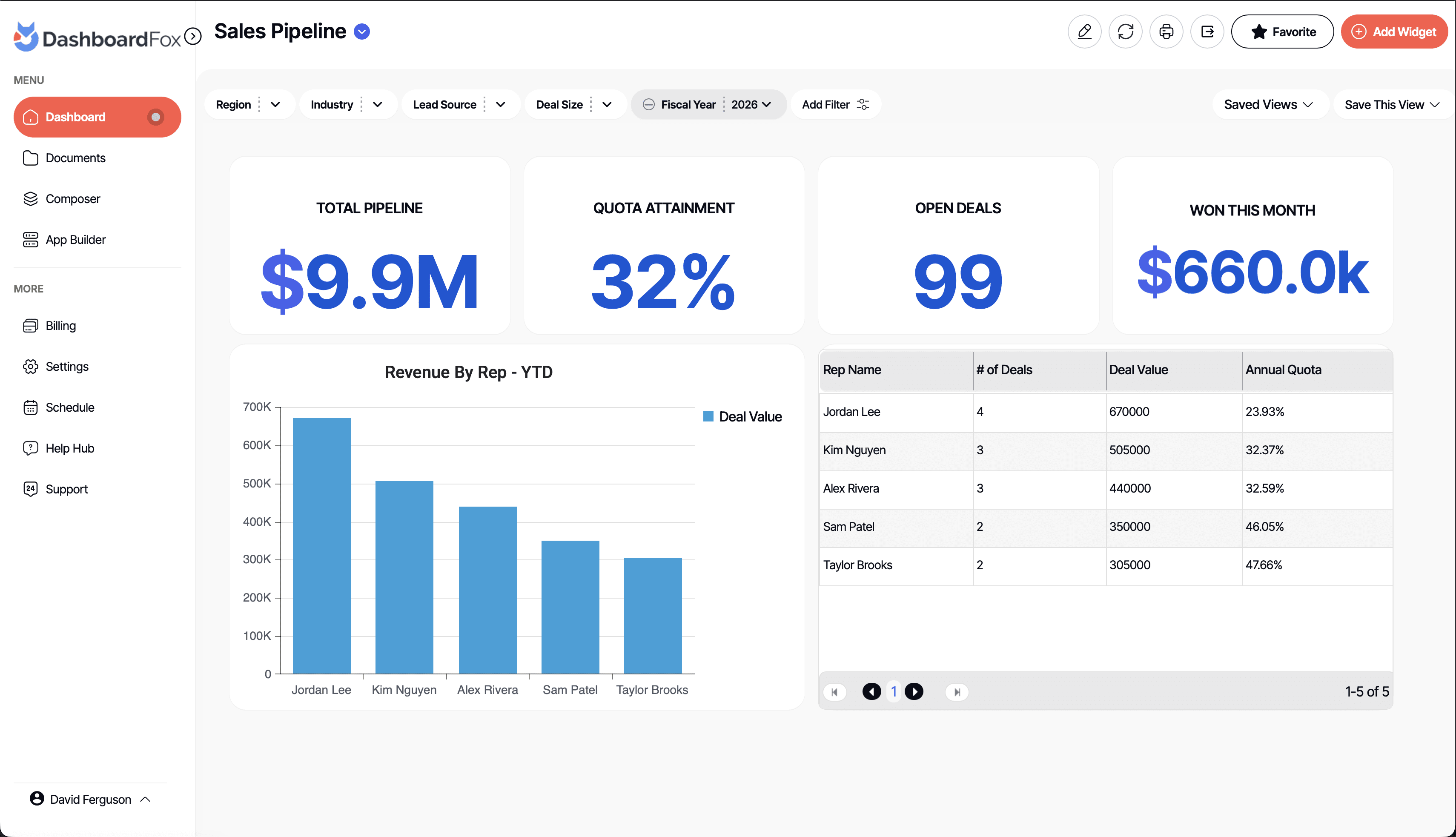
A finished analytics experience — not a starting point
Your customers don't get a chart widget — they get a complete self-service analytics environment under your brand, isolated to their data, configurable per tenant. See all features →
20+ chart types, ready to use
Bar, line, area, pie, donut, gauge, scatter, map, cross-tab, combo, and more. Every visualization is available out of the box — no chart library to integrate, no custom rendering code.
No-code ad-hoc report builder
Your customers drag fields, pick a chart type, set filters — and build their own reports from the data you've configured. No SQL. No ticket to your dev team. No waiting two sprints for a chart.
Dashboard builder
Customers arrange charts and grids into personal or shared dashboards. Smart Filters slice across all panels simultaneously. FastCache means dashboards load fast even under load.
Schedule & deliver
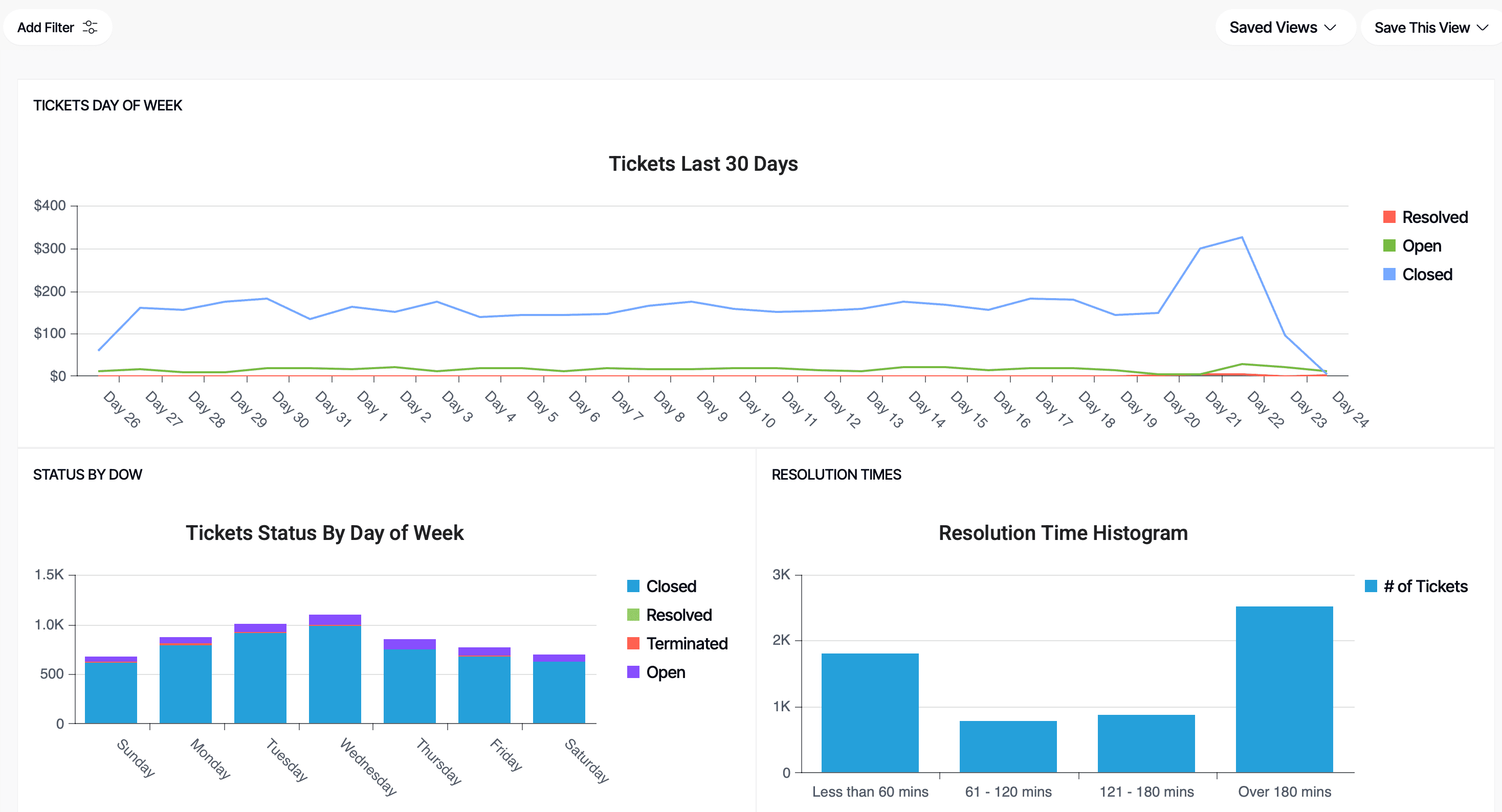
Automated report delivery on any schedule — daily, weekly, monthly — as PDF or Excel. App Shield ensures each recipient gets only their authorized data, automatically, on every delivery.
Export in any format
PDF, Excel, CSV — customers get their data in the format their workflow needs. Export works on any report or dashboard, with current filters applied.
No developer per request
After your one-time configuration, customers are completely self-sufficient. No more reporting tickets. No more "can you run this for me?" Your dev team is permanently out of the report-writing loop.
Three kinds of teams choose Yurbi
Embedded analytics for ISVs shipping to customers, teams replacing legacy BI, and enterprises whose data can't touch a vendor's cloud.
ISV & SaaS product teams
Your product generates data your customers want to see. Your dev team is either building reporting from scratch or keeping a fragile home-grown BI layer alive. Yurbi ends that tax — configure once, give customers self-service, get your engineers back.
See what Yurbi does Download Free TrialTeams replacing Crystal, SSRS, or Izenda
Your product already has embedded reporting — but every report change requires a developer, or the vendor was acquired and the roadmap stalled. Yurbi connects to the same databases and gives users self-service.
See all comparisonsEnterprise & security-conscious teams
Your data can't leave your environment and a cloud BI tool isn't an option. Yurbi is fully air-gap capable — no required outbound connections, installs on your own infrastructure, MS SQL backend for high-volume deployments.
See our security modelYour best engineers shouldn't be stuck maintaining reports.
It starts as a feature request. It ends with a chunk of your engineering team quietly running a reporting product you never set out to build.
What your team ships when reporting isn't their job
Teams that implement Yurbi consistently report the same thing: engineers stop maintaining a reporting layer and start shipping the product they actually sell.
A reporting layer isn't a project you finish. It's a tax you pay every sprint.
Building it yourself rarely shows up as a line item — it shows up as the roadmap that keeps slipping and the engineers you can never quite free up. The question isn't whether you can build it. It's whether the months your best people spend maintaining it are worth more than the product they're not building.
Configure once. Ship in weeks.
Yurbi is a configuration project, not a development project. Connect your database, define what customers can see, embed it. Done.
Connect your database
Point Yurbi at your existing database — SQL Server, PostgreSQL, MySQL, Oracle, and more. Read-only connection, no ETL, no data warehouse. Your data stays exactly where it is. See all supported databases →
Configure what customers can see
Map database tables to business-friendly concepts, define joins and calculated fields, set up tenant data isolation. The work that makes self-service possible — done once.
Embed and ship
Integrate Yurbi into your product UI via session token and embed URL. Customers see a branded analytics experience that looks native to your app — and start building reports without asking your team for anything.
Every plan, the same promise — so there's nothing to renegotiate later:
- Every feature in every tier — no paywalls between plans
- A flat annual price that doesn't move at renewal
- Runs on your infrastructure — your data never leaves your servers
- You reach the engineers who built it — not a first-tier support queue
Built specifically for ISVs — not adapted from enterprise BI
Embedded under your brand — customers never see "Yurbi"
Logo, colors, domain, login page — all yours. Each tenant can have its own branding. Your product, your brand, your URL.
Embedding & white-label →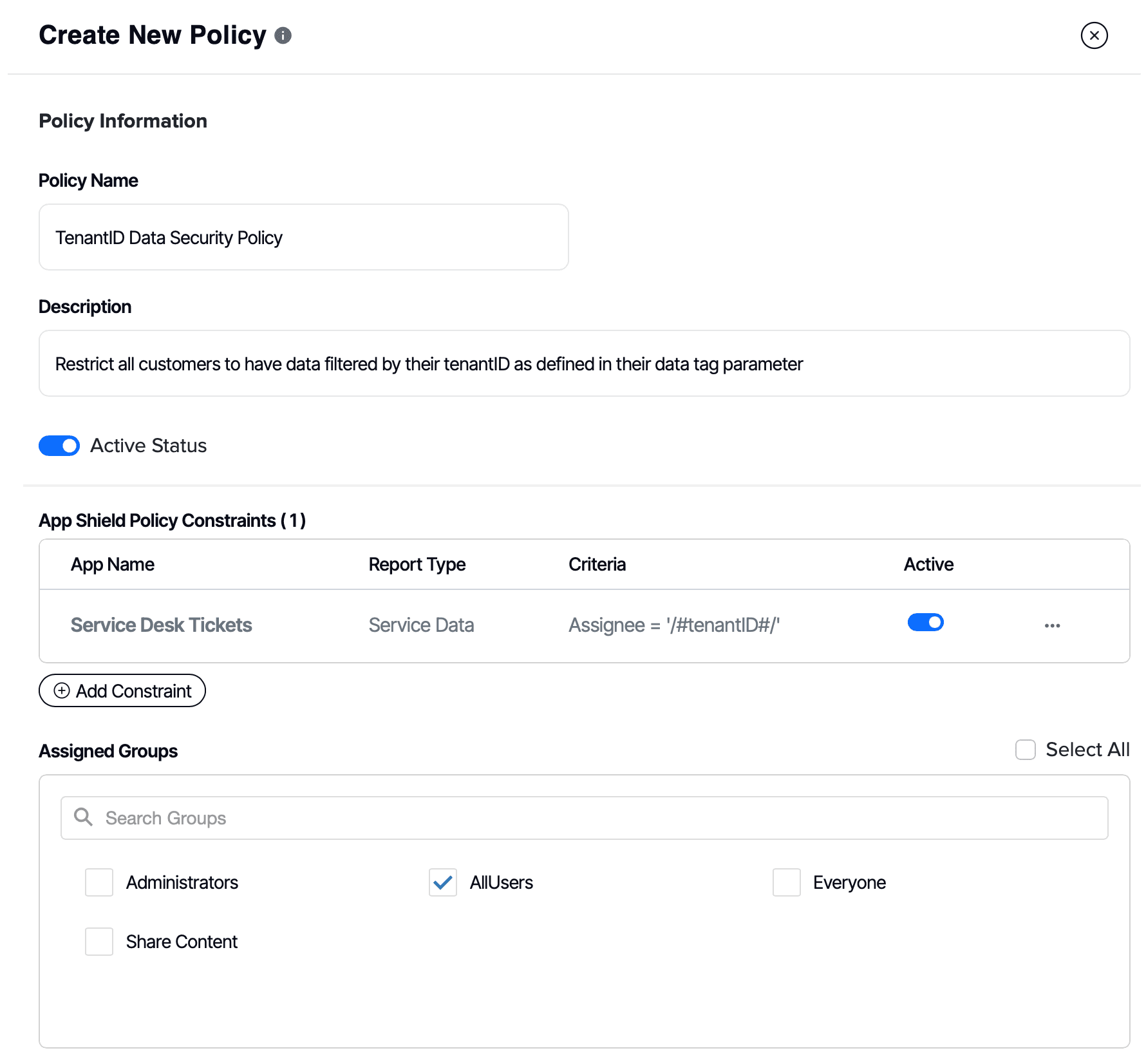
Multi-tenant security enforced at the query layer
Define App Shield policies once — tenant data isolation runs at query time, not in your app code. Cannot be misconfigured. Cannot be bypassed.
Security model →Published pricing — no sales call to see a number
Flat annual tiers, every feature in every plan, $500 per additional deployment. The only embedded analytics platform that's self-hosted, flat-tier, priced per deployment, and fully published — no other vendor stacks all four.
See full pricing →Running Crystal Reports, SSRS, or Izenda?
Crystal and SSRS were built for a pre-SaaS world — every report change still needs a developer. SSRS 2022 is Microsoft's final version. Izenda's roadmap stalled after acquisition. Yurbi connects to the same SQL Server databases and gives your users self-service — without rebuilding from scratch.
Your software ships to customer servers. Yurbi scales with that model.
Many ISVs deploy their software directly to each customer's environment — on-premise, customer-managed cloud, or a mix. Yurbi is built for this architecture.
Each deployment runs its own Yurbi instance — isolated, independently branded, no data crossing between customers. With dozens or hundreds of customer deployments, economics stay predictable where consumption-based competitors become impossible to budget.
A vendor you can actually work with
We've watched founders realize their sharpest engineers have quietly become a reporting team — that every sprint spent on dashboards is one the product didn't move forward.
When analytics are embedded in your product, you can't afford a vendor who treats your renewal as a profit center.
Enterprise embedded BI vendors
- Sisense — $21,000–$137,000/year, hidden behind a sales call
- Logi Symphony — four acquired products stitched together
- Tier-1 support — not the engineers who built it
- Power BI Embedded — consumption billing that spikes with traffic
Bootstrapped. One code lineage since 1999.
- Published pricing from $10,000/year — everything included
- 50–80% less than enterprise vendors for same capabilities
- One continuously-developed code lineage since 1999 — no acquisition baggage
- You talk to the engineers who built it — directly
- Predictable flat pricing — no consumption spikes
Common questions about Yurbi
Yurbi is a self-hosted embedded analytics platform for ISVs and SaaS companies. It adds a no-code report builder, 20+ chart types, dashboards, scheduling, and export inside your product — isolated per customer, branded as your product, running on your own servers.
Yurbi is a presentation and query layer — not ETL. It queries your existing application database directly in read-only mode. Nothing is copied or transformed. You configure what customers can see; they explore their data themselves, without ever asking your dev team for a report.
A complete self-service analytics environment: 20+ chart types, a no-code drag-and-drop report builder, dashboards they build and share, automated scheduled delivery (PDF or Excel), and multi-format export. All under your brand, on your domain, isolated to their data.
Customers are self-sufficient. They build reports, explore their data, and schedule delivery without ever asking your team for anything. Your dev team is permanently out of the report-writing loop.
No. Yurbi queries your existing application database directly in read-only mode. No ETL pipeline, no data warehouse, no new infrastructure. You point Yurbi at the database your product already uses, configure the semantic layer (what customers can see and what the fields mean), and you're done. Your data never moves.
Building multi-tenant embedded analytics from scratch means solving data isolation, white-labeling, query performance, a full no-code report builder, 20+ chart types, scheduling, export, and ongoing maintenance — typically consuming 20–30% of engineering sprint capacity indefinitely. That's a permanent reporting tax, not a one-time project.
Yurbi replaces that with a flat annual subscription and a configuration project measured in days. The Build vs. Buy calculator lets you put a real number on it.
Most teams reach production in 4–8 weeks: connect your database (1–2 days), configure the semantic layer (1–5 days), embed and ship (1–3 days). Teams with well-documented schemas and available developer time move faster.
Yurbi's professional services team can run all three steps if you need to move faster. See the full implementation guide →
Yurbi's Tenant Mode enforces data isolation at the platform level. Each tenant is assigned to a security group controlling which database, schema, or filtered view they can access. App Shield injects data-level constraints directly into the SQL query at execution time — on every report, dashboard, scheduled delivery, and export. It cannot be bypassed.
Works with shared databases (row/schema filtering) and per-tenant separate databases via dynamic routing. Full security model →
Nothing changes until you cross your plan's user cap. Flat tiers: Starter ($10K/yr, 75 users), Growth ($18K/yr, 250 users), Scale ($24K/yr, 500 users), Unlimited ($30K/yr). Moving up means paying the difference — no per-user penalty, no consumption billing.
Additional deployments are $500/year at list rate, with volume discounts after your first 10. Full pricing →
Yes. Yurbi is fully air-gap capable with no required outbound connections to 5000fish servers. It installs on your own infrastructure (Windows Server, Linux, or Docker), queries your databases read-only, and never transfers your data externally. Well-suited for healthcare, government, defense, and financial services deployments with strict data residency requirements. Full security model →
You're back to building the product you actually sell.
Here's what it looks like once Yurbi carries the reporting work your team used to.
- Your customers open your product and see analytics that feel built-in — branded as yours, fast, and theirs alone.
- Your engineers are shipping the features that win deals — not patching a report builder.
- Pricing is a number you set once and budget forever — and your data never leaves your servers.
- When you need something, you talk to the people who built the platform.